Dr Ayala Panievsky’s practical toolkit for journalists teaches them how to report on populists, discredit conspiracies and stay safe.
Threats to the media are threats to democracy itself, argues Dr Ayala Panievsky, Presidential Fellow at City St George’s, University of London. A former journalist, Dr Panievsky became increasingly concerned with the state of the media following Trump’s first presidential victory in 2016.
That same year, the Oxford Dictionary named ‘post-truth’ – a concept which refers to a world in which facts are deemed less important than personal opinions – its word of the year. Looking around her, she found examples of media-bashing, violence against journalists and the discrediting of journalists occurring worldwide.
Politicians such as Brazil’s former President Bolsonaro and senior US Government advisor Kari Lake have repeatedly made false claims about election fraud in their respective countries.
In Georgia and Hong Kong, journalists who are critical of their governments face jailtime or physical violence when covering demonstrations.
The threats are appearing online too. Hungary’s former Prime Minister Orbán and Hungary’s Prime Minister Fico both used paid-for Meta ads to discredit journalists and NGOs.
A war on media threatens democracy
“The war on media is not about journalists but about us – the people. If journalists weren’t powerful, populists wouldn’t put so many efforts into silencing them,” explains Dr Panievsky. “This is about media freedom and democracy.”
A rise in online violence, notably towards women journalists, means journalists are self-censoring to protect themselves against targeted harassment campaigns. This chilling effect harms the public’s right to know.
Without knowledge, citizens cannot make informed decisions on their politics.
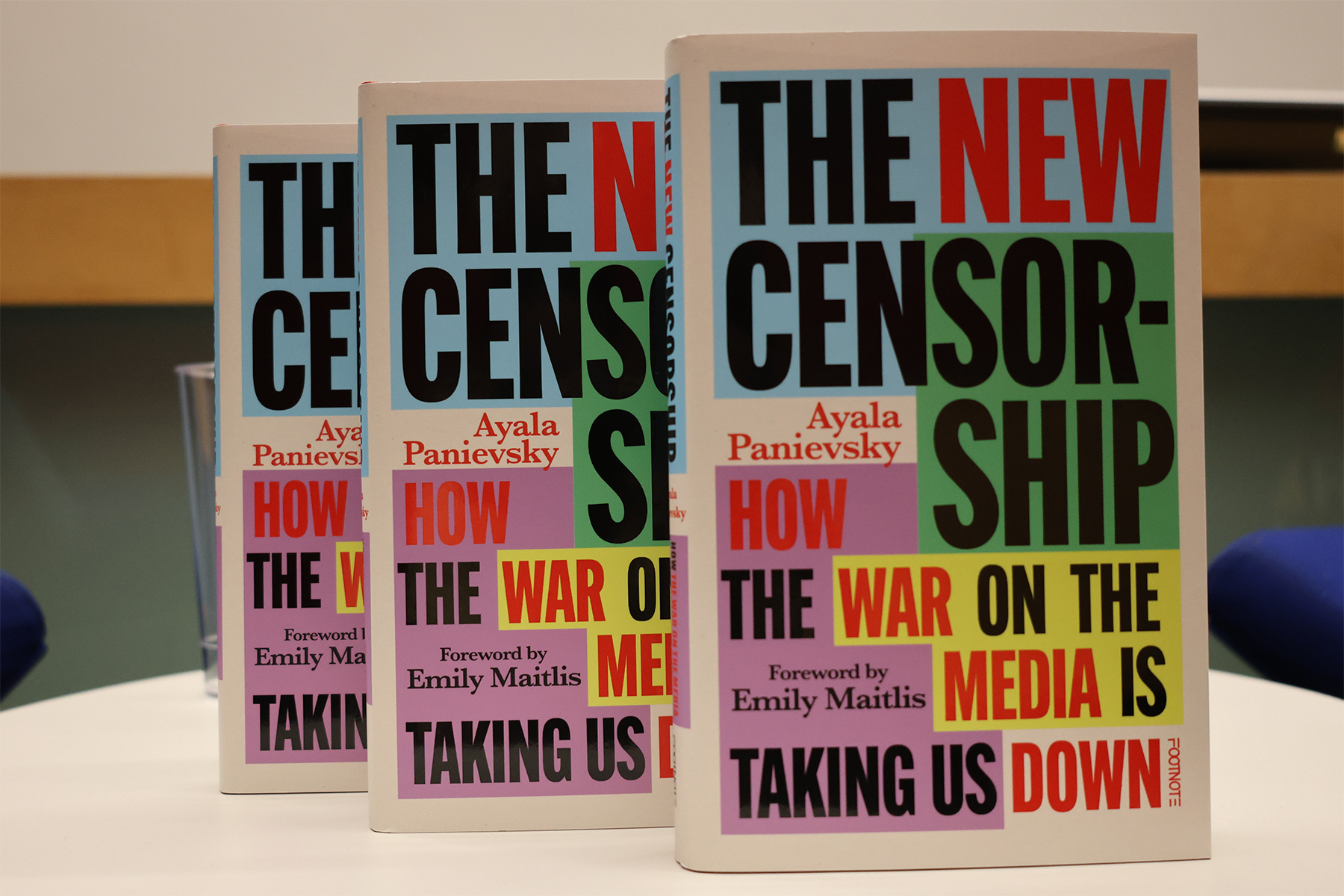
In response, Dr Panievsky’s 2025 book The New Censorship explores the past decade of journalism and underscores the ways in which the powerful have sought to keep control of the narrative.
To help train the next generation of journalists, Dr Panievsky worked alongside her colleague Michael Hauser-Tov from her former paper Haaretz, to transform the knowledge she had built up writing The New Censorship into a practical toolkit.
The project – called Newsroom CPR – was first launched at an event at City St George’s and is being delivered as a workshop to news organisations, unions and nonprofits.
Making the toolkit ‘super practical’ was of tantamount importance to Dr Panievsky.
“I know journalists out there are not exposed to this research,” she says. “I didn’t want this knowledge to be trapped in academia. We need to train our students to address what they are likely to see out there on the field.”
Don’t debate verifiable facts
Dr Panievsky found that modern-day censorship relies less on banning stories and instead on flooding information systems – a Russian technique known as the ‘firehose of falsehood’ propaganda method.
Trump – and other populist leaders like him – know how to game the modern media ecosystem, with its always-on ubiquitous nature.
When journalists breathlessly report on every outrageous claim a politician makes, they run the risk of being used as these populists’ mouthpieces and inadvertently allowing the politicians to control the narrative.
Propagandists also use social media bots to post hundreds or thousands of times and fill up a timeline. With an overwhelm of news, audiences simply tune out, unable to parse fact from fiction.
For journalists concerned about reporting objectively, Dr Panievsky warned that their role was not to balance stories that are unbalanced.
“Most topics have more than two relevant angles,” Dr Panievsky says, “but you don’t need to bring two people on [a broadcast news segment] – one to say the truth one to tell a lie.”
Pre-bunk rather than debunk claims
Politicians can easily spread conspiracy theories and make fake claims but it might take hours, days, or months for journalists to debunk them.
By the time a correction is issued, the audiences who were fed the initial lies are likely to have moved on.
“We need to be more active on factchecking,” says Dr Panievsky.
Her top tip to journalists is to pre-bunk conspiracies rather than waiting to debunk.
“There’s something to be said about setting the scene,” she explains. “Often you can anticipate what kind of conspiracies are coming your way and you can warn your audience, especially if you’ve been working on the same beat for a long time.”
This technique is proven to work by Professor Sander van der Linden, who coined the concept of psychological inoculation, as it puts audiences on alert to look out for lies.
Solidarity and taking back control
Far from being doom and gloom, Dr Panievsky knows there are solutions and she argues that solidarity and collaboration are part of the answer.
If a journalist’s question is being ignored by a political leader during a press conference, she encourages every other journalist in the room to repeat it until it is answered.
Journalists will not benefit from their competitors failing, so she urges them to collaborate, particularly if they work on different subject areas or in different mediums.
Being bolder in protecting the status of journalism is another of her key lessons. “We need to agree on who is a professional journalist,” she says. “We cannot let big corporations do that.”
To achieve this, Dr Panievsky calls on journalism associations and unions to be strengthened.
She wants Newsroom CPR to be an evolving toolkit that journalists can contribute to with techniques that have worked for them.
“There is by now enough evidence per country that shows solidarity is not just about feeling good, it’s the way to survive this,” Dr Panievsky says.